Introduction
- In 1508, Pope Julius II called Rafael to the Vatican to do a few painting jobs for him.
- Over the next 12-13 years, for Pope Julius II and his successor Pope Leo X, he painted 4 main works being:
- Stanza della Segnatura (1508–11)
- Stanza d’Eliodoro (1512–14)
- Stanza dell’Incendio (1514–17)
- Sala di Costantino (1517–25)
- The Stanze della Segnatura, later known as Stanze di Raffaello, was in one of Pope Julius II’s rooms in the Papal Apartments
- He painted four paintings on each of the four walls
- On the smaller walls he painted Parnassus and Cardinal Virtues
- On the larger walls he painted Disputa and The School of Athens
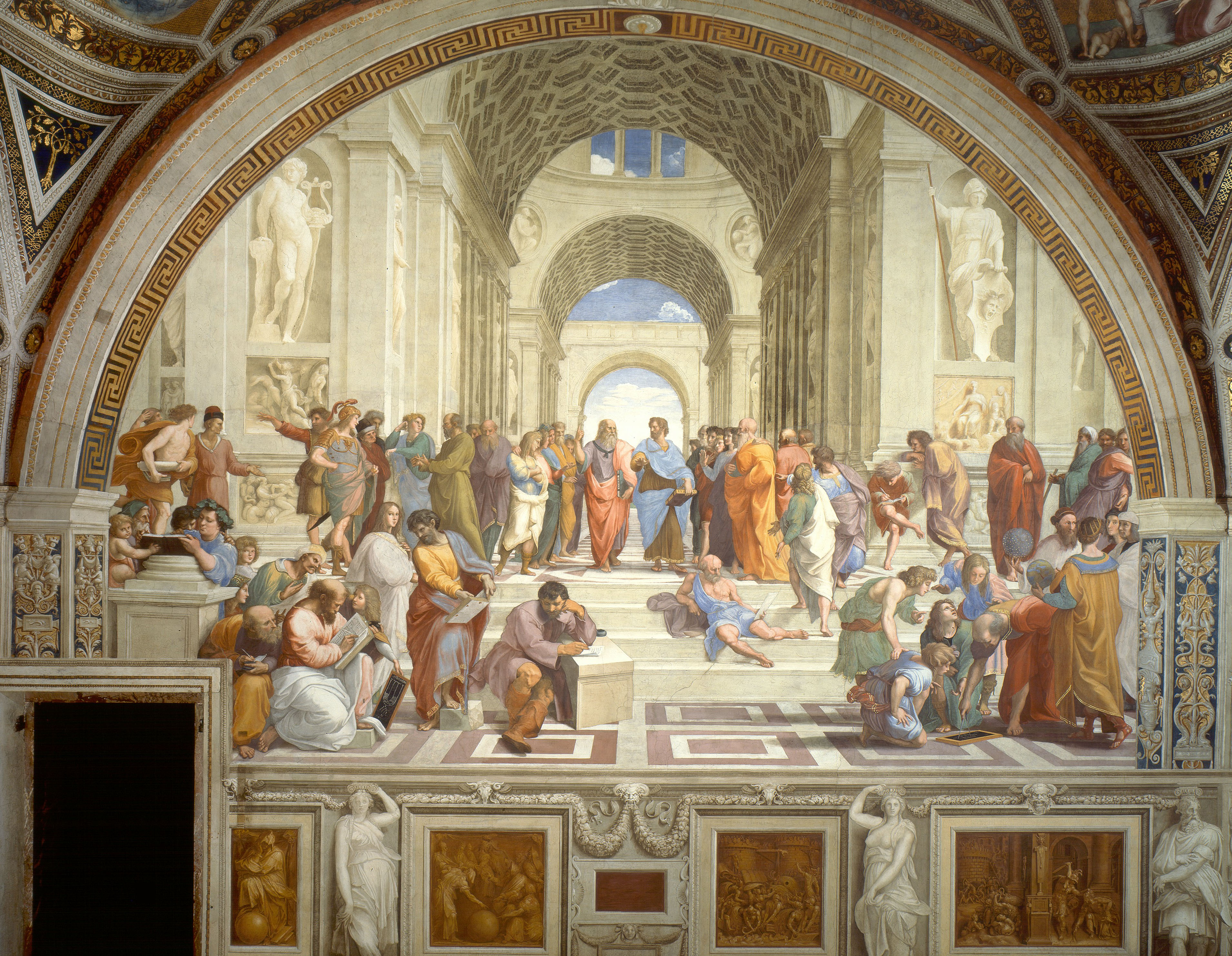
School of Athens
- The School of Athens is a fresco that heavily portrays humanism and secularism
- The painting includes many famous renaissance and pre-renaissance philosophers, thinkers, and artists such as Michelangelo, Pythagoras, Ptolemy, Euclid, and even Rafael
- In the center of it all, there was Plato and Aristotle
- He didn’t add any religious aspects to it and made all of the people to be human-like
- All of these people were people that helped push the ancient world forward into a new, modern world
- In the painting, Plato is shown to be pointing to the sky, symbolizing “beyond earth”, or religious beliefs
- On the other hand, there is Aristotle, who is shown to be pointing to the ground
- He is essentially saying that humans should focus on humans and human principle rather than god, which is essentially humanism and secularism
- Around all of this, Rafael included Greco-Roman architecture to add a feeling of peace and sublimity
- He uses perspective to make it look three-dimensional and makes the view get smaller and smaller to the point where everything in the distance is just one dot
- The main reason that this painting got a lot of attention is that it portrayed such deep meaning in such a beautiful way
Dimensions: 5.79 m x 8.24 m