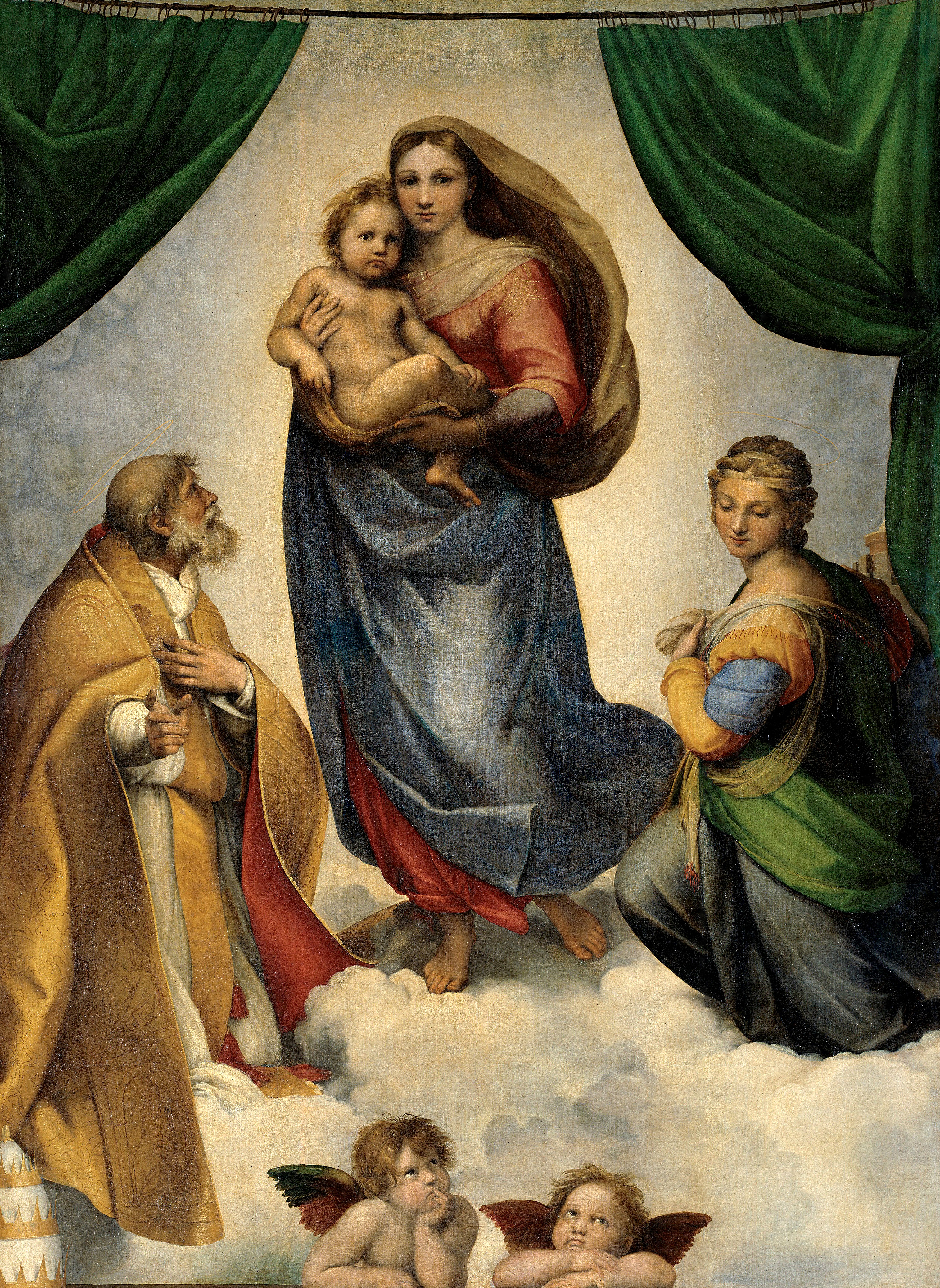
What Is The Sistine Madonna?
- The Sistine Madonna is one of the most influential renaissance artworks ever painted
- It was first commissioned by Pope Julius II in July 1512
- It was finished in 1513
- It shows a saint's vision of the clouds, of heaven uniting with earthly figures
- A virgin steps out holding baby Christ
- Motivated by the countless angels in the background, she takes out and introduces baby Jesus to the world
- On the right and left, Pope Sixtus II and St Barbara, both martyrs, lead the way
- The painting has switched many hands, first in 1754 moving to a few fortresses and castles
- During WW2, Hitler got a hold on the piece, soon to fall to the Soviet Union’s hands
- Finally, it was returned in 1956 to Berlin and then Dresden, Germany where it remains today
The Meaning And Legacy Of The Sistine Madonna
- The Sistine Madonna showed humanism in many ways
- All of the figures are drawn realistically and modeled directly as if the figures were human, away from the style of classic medieval style paintings
- Raphael also attempted to show the natural beauty of a human - realism
- The Sistine Madonna was already a valuable and masterpiece of the arts when it first came on, but it grew in popularity as time went on
- The painting was seen as an original example of renaissance art, on which there were many pieces of work copying or quoting the artwork
- Poems and pieces were written on the painting, describing its beauty
- However, the most famous piece of the painting is the two cherubs (angels) on the bottom of the picture
- It is thought to be the last thing Raphael added, only because the bottom looked a little empty
- Over time, those two angels became immensely popular, becoming icons and were being used everywhere from keychains to keepsakes
- The legacy of The Sistine Madonna was vast: symbolizing core renaissance humanistic art, inspiring many artists and writers, and becoming a cultural icon with the two cherubs
Quick Facts
- Width: 201 cm
- Height: 269.5 cm
- Painting: 1512 - 1513
- Location: Dresden, Germany
- Commissioner: Pope Julius II (July 1512)
- Painter: Raffaello Santi (Raffaello Sanzio da Urbino)
- Estimated Value: ~$300 million+